
India-Canada Trade to Double or Triple in the Coming Years: Hemant M. Shah
An Interview with a Senior NRI Businessman, Popularly Known as ‘Mr. India’ in Canada
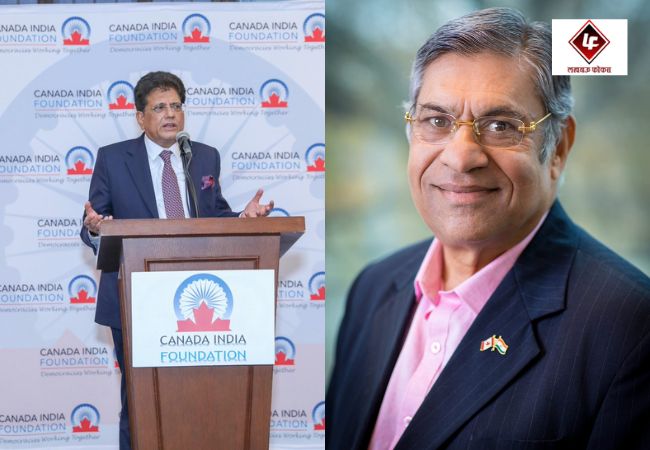
- Lucknow Focus News Desk: India’s Minister of Commerce, Piyush Goyal, recently concluded a visit to Canada. He received a rousing welcome from the business community there. Accompanying Mr. Goyal was a 150-member business delegation comprising individuals from various sectors across India. This visit proved to be highly successful, marking significant progress toward establishing a framework for the Comprehensive Economic Partnership Agreement (CEPA). This trade pact is slated to be implemented by the end of 2026. Following this visit, Akhilesh Mayank Editor of Lucknow Focus spoke with Hemant M. Shah of the Canadian Hindu Chamber of Commerce to discuss India-Canada trade relations (In Canada, members of the Canadian-Indian community call Mr. Shah ‘Mota Bhai’ (Big Brother).), specifically the reactions of the Indian diaspora business community in Canada and the future prospects. Mr. Shah has served as a bridge between India and Canada’s trade relations for the past 50 years. Excerpts from the interview:
Q.- India’s Minister of Commerce, Piyush Goyal, recently visited Canada. He participated in events organized by several organizations, including the ‘Indo-Canadian Chamber of Commerce.’ As a businessman, how significant do you consider this visit to be for the trade relations between the two nations? How would you describe the overall outcome of his trip?
Ans–This visit was a highly positive step, taken at precisely the right time. It can be described as an immensely successful visit. Notably, Canadian Prime Minister Mark Carney also met with the Indian Commerce Minister during this trip-an occurrence that is generally uncommon, as the Canadian Prime Minister typically does not hold meetings with ministerial-level delegations or leaders. The Commerce Minister’s visit has effectively bridged the slight diplomatic distance that had appeared between the two nations over the recent past. The fact that the Indian Commerce Minister has arrived with a delegation of over 100 companies-the largest of its kind to date-demonstrates the seriousness with which the Indian government views the Canadian market. For Canadian business professionals, this marks the beginning of a renewed sense of confidence.
Q.– It is anticipated that the trade agreement between India and Canada will come into effect by the end of December this year. What direct benefits can business professionals of Indian origin expect to derive from this agreement within the Canadian market? What role do you envision for yourself in this process?
Ans-The most significant benefit of the Comprehensive Economic Partnership Agreement (CEPA) coming into force by December will be the reduction of both tariff and non-tariff barriers (customs duties). For Indo-Canadian business professionals like us, the cost of directly importing goods from India-or exporting technology from here to there-will decrease. This will significantly enhance our competitive edge within the Canadian market. As for my own role in this endeavour, I intend to contribute whatever modest effort I can-however small-to support this initiative.
Q.-The primary objective of the Minister’s visit was to finalize the framework and foundational structure of the trade agreement. In your opinion, which key policy relaxations or regulatory provisions are most essential to include within the framework of this agreement? Piyush Goyal also reportedly suggested that new entrepreneurs should look to those who have been active in this field for 50 years as their mentors. What are your comments on this?
Ans– Business professionals are keen to see an easing of the movement of professionals and skilled labour between the two nations. Furthermore, regulations designed to safeguard investments must be made transparent to ensure the financial security of companies on both sides. Your information is accurate; Piyush-ji did indeed make this observation. We absolutely must leverage the wealth of experience possessed by those who have dedicated 5 decades to this field by adopting them as our mentors. There is absolutely nothing amiss with this suggestion of his.
Q.– Given the current global landscape, in which sectors do you see the greatest and most immediate potential for bilateral trade between India and Canada at this time?
Ans. The possibilities are limitless. Currently, Canada is in dire need of affordable pharmaceuticals, textiles, and IT services-sectors in which India is a global leader. Conversely, India requires pulses, potash (fertilizers), critical minerals (such as lithium and cobalt), and clean energy technologies from Canada to cater to its vast population.
Q.– Beyond traditional trade sectors (such as pulses or precious stones), has the scope for collaboration between the two nations expanded into newer domains like technology, renewable energy, or digital startups?
Ans– Absolutely; the era of relying solely on traditional trade is fast becoming a thing of the past. The real momentum now lies in Artificial Intelligence, Clean Tech, Agri-Tech, and Renewable Energy. Canada possesses cutting-edge, eco-friendly technologies, while India offers the world’s largest digital infrastructure and market—providing the perfect platform to implement these technologies on a massive scale. This synergy should be leveraged to its fullest potential.
Q.– The Canadian Hindu Chamber of Commerce is currently operating with remarkable vigour in Canada, despite having been established just five years ago. How do you view the Chamber’s professional role and its collaborative dynamics with other business organizations? Union Minister Piyush Goyal, too, emphasized in his address that all Indo-Canadian regional chambers should work together in unison. You had, in fact, congratulated him on his ‘X’ handle regarding this very sentiment.
Ans- Newer organizations like the Canadian Hindu Chamber of Commerce are playing a pivotal role at the grassroots level-fostering cultural connections and bridging the gap for SMEs and small-scale entrepreneurs. The harmonious co-existence of these entities serves to further strengthen the fabric of business networking.


